
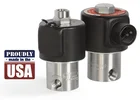
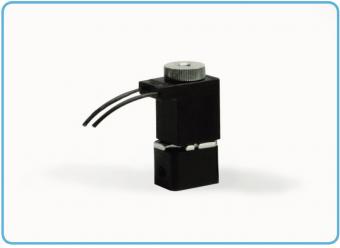
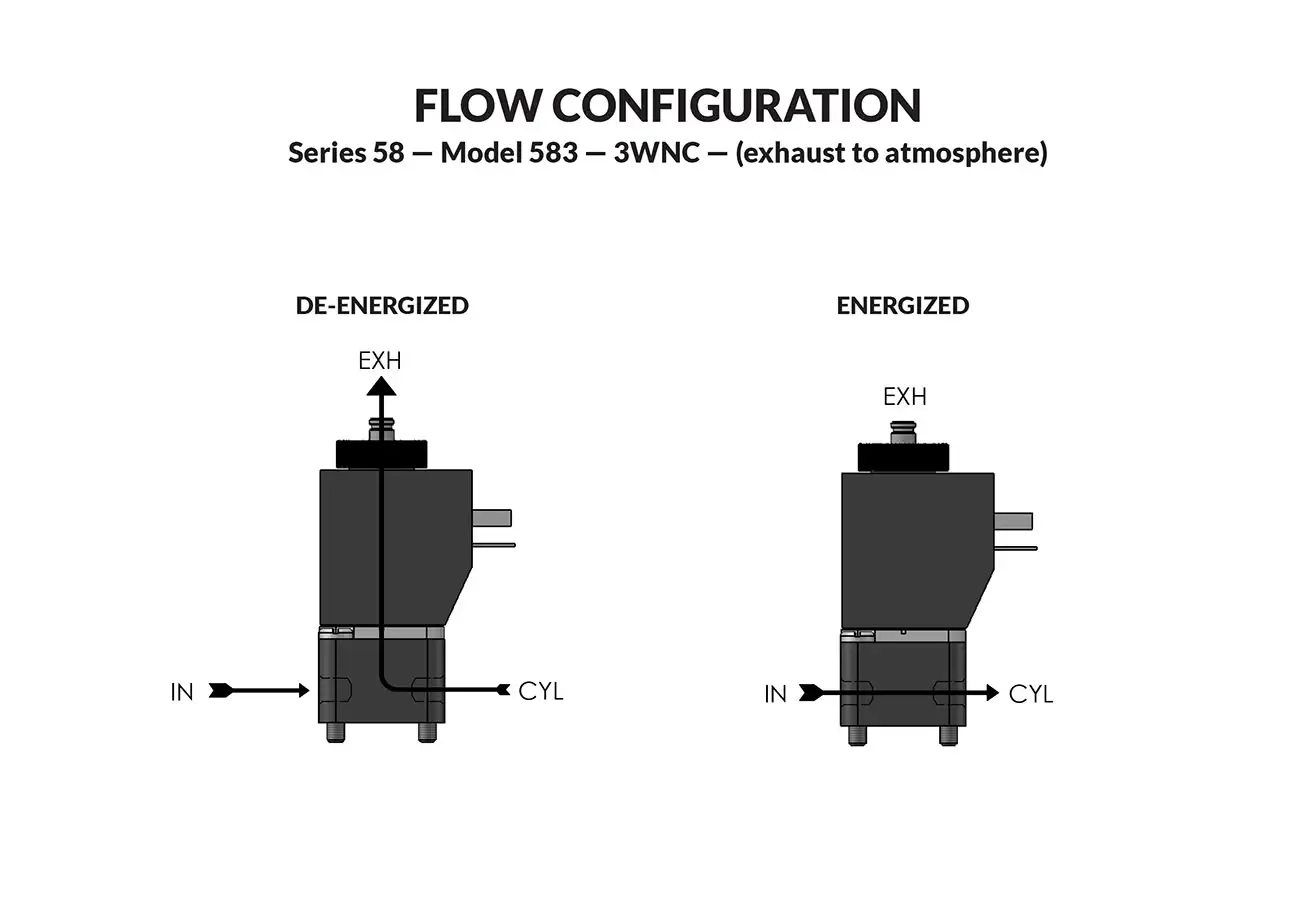
3-Way Normally Closed Valve (Exhaust to Atmosphere)
Easily interfaced with circuit boards and miniaturized components. The versatility is for connecting electronic signals to pneumatic outputs. The small size is ideal for stand alone (with #10-32 UNF-2B ports) or multiple valves mounted on one manifold. Air and other common gases — filtration recommended — 30 microns or less.
- May be used to "pilot" larger valves.
- Ideal for micro electronic production equipment.
- Great for medical and chemical analytical applications.
- Can operate directly from most programmable controllers.
- High quality engineering.
| MAX. OPER. PRESS. DIFF. | ORIFICE SIZE | CV FACTOR | VALVE NUMBER | ||
|---|---|---|---|---|---|
| DC | INLET | EXH | INLET | EXH | LEADWIRE |
| 300 | 0.6 mm | 0.6 mm | .010 | .010 | 583AA19DGM |
| 300 | 0.6 mm | 0.8 mm | .010 | .020 | 583AF19DGM |
| 250 | 0.8 mm | 0.8 mm | .020 | .020 | 583FF19DGM |
| 145 | 1.0 mm | 1.0 mm | .030 | .030 | 583MM19DGM |
| 100 | 1.2 mm | 1.2 mm | .034 | .034 | 583WW19DGM |
* Stainless Steel Bodies
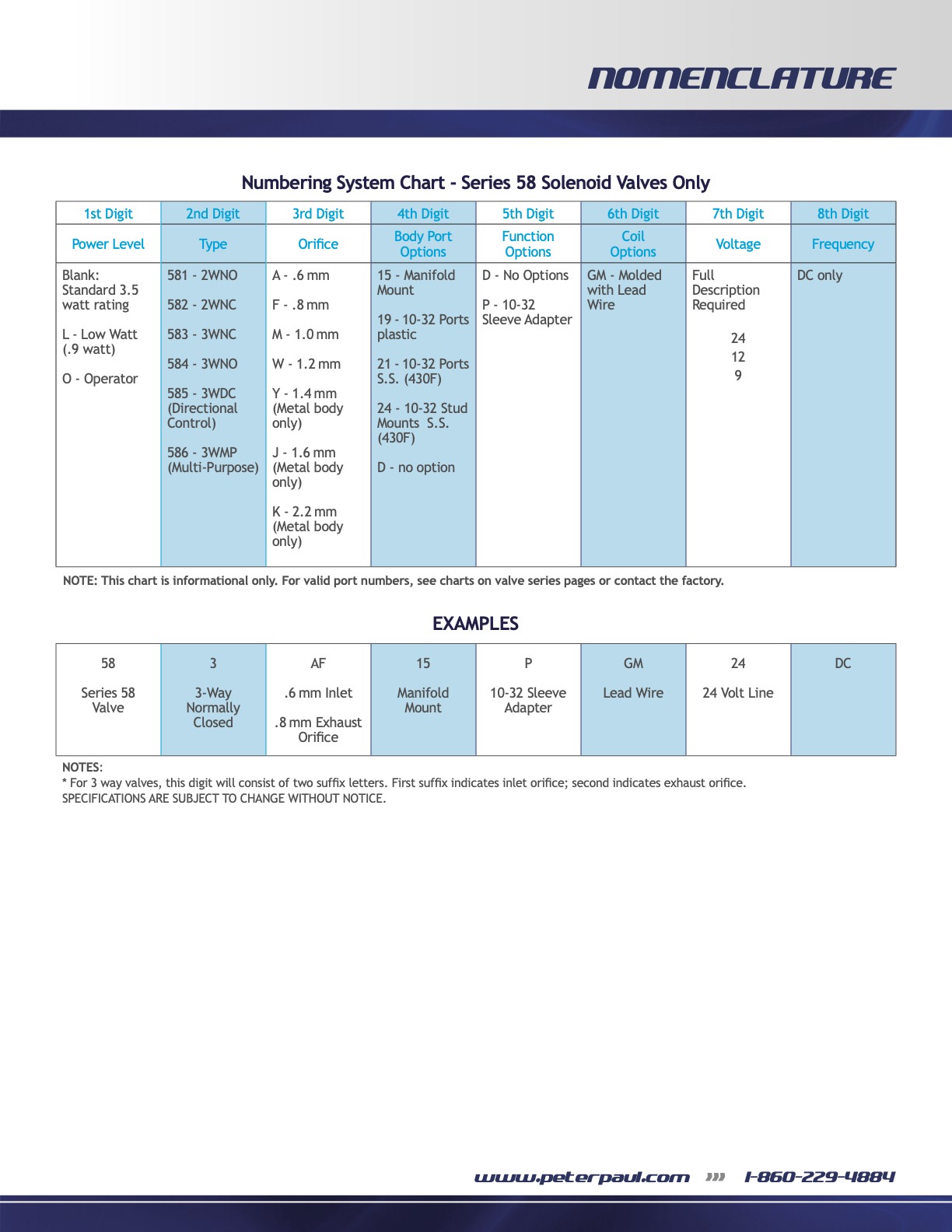
Ordering Information:
When ordering valves or repair packs add voltage and frequency to complete valve number. for examples: valve (582M19DGM 120/60) repair pack (K582M19 AC)
When ordering operators add the letter “O” to the front of the valve number, replace body port number with the letter “D”: example: operator (O582MDDGM 120/60)
Operating Conditions
- Media
- Air and other common gases — filtration recommended — 30 microns or less.
- Valve Temperature Range
- Standard Valves – 5°F (-15°C) to 122°F (50°C) ambient; media.
- Maximum Operating Pressure Differentials
- See table above.
- Burst Pressure
- 1500 PSI
- Leakage
- Bubble tight for standard valves.
- Vacuum
- To 5 Microns*
Electrical Characteristics
- Coil Voltage
- 12, 24/DC
- Nominal Power
- DC — 3.5 Watts
- Coil Construction
- Molded Class A with leadwires
- Typical Response Time on Air
- DC — 9 Milliseconds
- Operating Speed
- Up to 1000 CPM
- Duty Cycle
- Continuous
Mechanical Characteristics
- Body
- Polyester Plastic (Std.), Stainless Steel (Opt.)
- Internal Components
- Stainless Steel
- Elastomers
- Nitrile (Buna) (Std.). Many other elastomers available.*
- Orifice Diameter
- See table above.
- Porting
- #10-32 UNF-2B
- Life Expectancy
- Millions of cycles, depending on application, lubrication, etc.
- Valve Weight
- 0.13 lbs
- Repair Packs
- See table above.
- Options
- Round Stainless Steel, Male Stud Mount, and Manifold Mount*
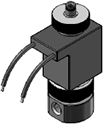
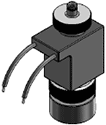
Series 58 Model 583 (exhaust to atmosphere) Molded Leads
Cv Flow Formulae
PeterPaul has created this page for you so you can calculate the flow or Cv (flow coefficient) to make the relationship visible between the pressure drop (the difference in pressure between two points of a liquid/gas carrying network) and the flow rate.
The use of this flow coefficient (Cv) calculator offers a standard calculation to compare valve capacities and sizing for a wide range of applications. The type and sizing of a valve or regulator can have a large impact on the performance of the assembly for transferring gas or liquids in the system.
Our sales department is ready to answer questions and to solve your valve needs. Please feel free to call, chat or email us.
Liquid Flow
Gas Flow P2 > 53% of P1 (subsonic)
Gas Flow P2 < 53% of P1 (sonic)
DISCLAIMER: Gas flow is only an approximation using Cv.